Why every company should put its name on The Pillar
By Vladislav Gerasimchuk · · 12 min read
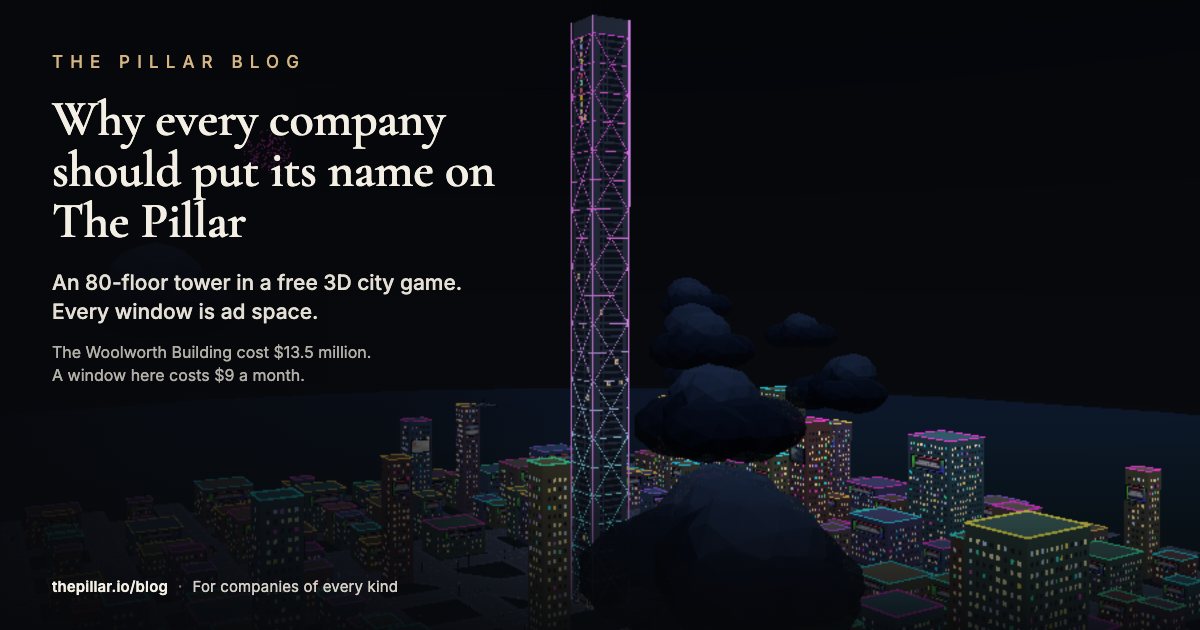
Companies have put their names on tall buildings for more than a hundred years. The Woolworth Building opened in New York in 1913 as the tallest building in the world. Walter Chrysler paid for the Chrysler Building out of his own income and put replicas of his cars' radiator caps on its 31st floor. In 2014, Salesforce agreed a lease worth $560 million that came with the naming rights to what became the tallest tower in San Francisco. A name on a skyline tells everyone who sees it that the company exists and means business. The Pillar offers a small version of that at a price any company can try: an 80-floor tower in a free 3D city game, where each of the 1,920 windows and 187 billboards is ad space rented by the month.
The Pillar is a free 3D city game in the browser with an 80-floor tower in the middle. Any company can put its logo on one of the tower's windows for $9 to $392.85 a month, or on a billboard in the city for $4 to $8, with a link to its site and no contract.
- Naming a real building costs millions. Salesforce's 2014 tower lease with naming rights was worth $560 million, and Crypto.com's 2021 arena deal was $700 million over 20 years.
- On The Pillar, a company's logo goes on an 80-floor tower from $9 a month, or on a city billboard for $4 to $8, paid monthly with no contract.
- Every window has a panel with your pitch, a second line, a link and a view counter, and its own share page with a preview card.
- Agencies, B2B firms, food and drink brands, nonprofits, event organisers and companies that are hiring each have a natural way to use a window.
- The Pillar is new and its audience is small. Use it as one more place your name shows up, and keep your lead channels where they are.
Why do companies put their names on buildings?
To be seen and remembered by people who aren't looking for them yet. A name on a tall building works all day without anyone clicking anything, and the building lends the name some of its weight. When the Woolworth Building opened on April 24, 1913, President Woodrow Wilson pressed a button in Washington to switch on its lights, and it was the tallest building in the world. It cost $13.5 million, according to Wikipedia, and in a 1916 booklet the minister S. Parkes Cadman called it "The Cathedral of Commerce".
The Chrysler Building was the tallest in the world for 11 months, from May 1930 until the Empire State Building passed it in May 1931. Walter Chrysler paid for it with his income from the car company, and its 31st floor carries replicas of the 1929 Chrysler radiator caps, so the building itself advertised the cars.
San Francisco has two examples. The Transamerica Pyramid, finished in 1972, was the city's tallest building until 2017, and Transamerica still shows the pyramid in its logo after moving its headquarters to Baltimore. In April 2014, Salesforce agreed a 15-year lease worth $560 million for 30 floors of a new tower, which earned it the naming rights, as KQED reported. Salesforce Tower took the title of the city's tallest building from the pyramid.
Names on arenas cost even more. In November 2021, Crypto.com agreed to pay $700 million over 20 years to rename the Los Angeles arena that had been the Staples Center, Al Jazeera reported.
| Year | Company | Building | What it took |
|---|---|---|---|
| 1913 | Woolworth | Woolworth Building, New York | $13.5 million to build |
| 1930 | Chrysler | Chrysler Building, New York | Paid for by Walter Chrysler from his car-company income |
| 1972 | Transamerica | Transamerica Pyramid, San Francisco | Still on the company's logo after it moved out |
| 2014 | Salesforce | Salesforce Tower, San Francisco | A 15-year lease worth $560 million, with the naming rights |
| 2021 | Crypto.com | Crypto.com Arena, Los Angeles | $700 million over 20 years for the name |
| 2026 | Any company | The Pillar | A window from $9 a month |
Why pay to be seen if nobody clicks?
Because familiar names tend to get picked. Psychologists call this the mere-exposure effect: people tend to like things more simply because they've seen them before. In 1968 Robert Zajonc reported in the Journal of Personality and Social Psychology that people rated familiar words, shapes and photographs more positively than similar ones they hadn't seen, as the Wikipedia summary of his work explains.
It's one reason companies put their names on stadiums, team shirts, buses and buildings, where nobody can click. Most online advertising sells something else. Search and social ads charge per click or per thousand views, and they stop when the budget runs out. A steady presence online, a spot where your name simply stays, is harder to find and rarely cheap.
The Pillar sells that kind of presence by the month. Your name sits on the tower or on a billboard for every visitor, all day, at one flat price. We can't tell you how many people will see it. You get a fixed spot in a place people come to explore.
What a window gives a company
A window is your logo on a pane of glass on the tower, lit day and night for as long as you pay. Anyone who taps it opens a panel with your company name, a pitch of up to 140 characters, a second line of up to 80 characters and a link to your site. The panel also shows a view counter, which goes up by one each time someone opens your window and counts real opens only.
Every lit spot has its own page too, at thepillar.io/w/ plus the spot's id. Posted on LinkedIn, X or Slack, that link unfurls into a preview card with your logo, name and pitch, and anyone who opens it is flown to your spot on the tower. Your company also appears in the directory, the page that lists every company on The Pillar with a link to its site.
A billboard puts your logo, or a full banner image, on a sign on top of a building in the city around the tower. It's the cheaper option, and the better one if you have a product photo or a strong image.
The Pillar is a 3D open-world browser game and an advertising marketplace. A window is a licensed ad pane on its 80-floor tower, not real property and not a security. You hold a licence to show your name, logo and link for the months you pay for, and the Advertising License page has the full terms.
Players can wreck cars and set trees on fire, but the weapons skip the windows and the billboards entirely, so your name never ends up scorched.
What does it cost to put a name on The Pillar?
A window costs $9 a month on the bottom floor and about 4.5% more on each floor above it. That puts floor 10 at $13, floor 30 at $32, floor 50 at $78 and floor 80 at $291. The two panes at the corners of each face cost 35% more, so the top corner is $392.85. Billboards cost $4 to $8, by how visible their building is.
| Spot | Price |
|---|---|
| Floor 1 | $9 / mo |
| Floor 10 | $13 / mo |
| Floor 20 | $21 / mo |
| Floor 30 | $32 / mo |
| Floor 40 | $50 / mo |
| Floor 50 | $78 / mo |
| Floor 60 | $121 / mo |
| Floor 70 | $188 / mo |
| Floor 80 | $291 / mo |
| Floor 80, corner pane | $392.85 / mo |
| City billboard | $4 to $8 / mo |
There are no setup fees and no contract. You pay monthly through Stripe, and the price stays the same all month whatever the weather in the game or the hour of the day. Cancel from your desk at thepillar.io/desk or by email, and your name stays up until the end of the month you've paid for.
Salesforce's lease worked out to about $37 million a year. On The Pillar, a full year of the most expensive window costs $4714.20, and a year on floor 1 costs $108. A window in a browser game is a much smaller thing than a skyscraper in San Francisco, and it's priced like one: a small company can test it without asking anyone for a budget.
What should each kind of company put on its window?
The panel gives you three lines to work with: your name, a pitch and a short second line that most companies use for a price. Here is how different kinds of companies can fill them.
Agencies and studios
A window works as a calling card. Use the pitch to say what you build and for whom, such as "Shopify stores for food brands, designed and built in-house", and link to your case studies. A 3D city running in a browser is a fair example of what the web can do now, which makes a good backdrop for a studio's name.
B2B companies
Say what problem you solve in plain words, since the people reading it may not know your category. Use the second line for "Free demo" or "Plans from $49 a month", and link to the page where someone can book or start. Make sure the link opens a page that works for a stranger, rather than a login screen.
Food and drink brands
Put the product on a billboard. A can, a bottle or a box reads at a glance from a moving car, and a full-bleed banner shows it at the full size of the sign. Link to your shop or a store finder, depending on where people buy you.
Local businesses that sell online
A bakery that ships, a coffee roaster with a web shop or a studio that sells classes online can link a window straight to the order page. Visitors come from anywhere, so lead with what you sell and where you ship, and leave your street address for the site.
Companies that are hiring
Use the pitch for the role, such as "We're hiring two backend engineers, remote in Europe", and link to the job post. A window can't be edited after checkout yet, so rent it for the month the role is open and release it once you've hired.
Nonprofits and causes
Lead with the mission in one line and link to the page where people can donate or volunteer. Billboards start at $4 a month, which is small enough to try for a month and see what happens.
Events and conferences
Rent a spot for the month before the event and put the date and city in the pitch. A date is fine here, because you'll release the window after the event anyway. Link to the ticket page.
Everyone else
Anything legal that's yours to show can go up: a hotel, a law firm, a podcast, a game studio, a browser extension. If people can reach you through a link, a window can point them there.
Which floor should a company pick?
Pick by what you want the window to say. Low floors are the cheapest way to be on the tower at all, with floor 1 at $9 a month. From about floor 20 up, windows rise above the buildings around the tower, so they can be seen from further across the city and from the air. Higher still, a window looks more established, the way an office on a top floor does.
Corner panes sit at the edge of a face and cost 35% more. Each face of the tower looks out over a different part of the city, and the elevator lets visitors swipe around all four, so a window on any face can be found.
If you have more than one product or office, you can rent more than one spot. Each window and billboard is its own monthly licence, and your desk lists every spot you hold.
How visitors come across your name
The page opens on a wide view of the city at night, with the tower in the middle of the frame, so your window is somewhere in the first thing every visitor sees.
After that, visitors explore. The elevator runs all 80 floors and lets them circle the tower face by face, close enough to read the glass. Cars, a helicopter, a plane and a wingsuit take them across the city, past the billboards.
Some visits come with a reason to look closely. Every evening at 19:10 New York time the Golden Window hunt starts: players search the tower's dark windows for the one hiding a prize, and the first finder wins a week on that window with their X avatar on it. Other visits come through links. The directory lists every company with a link to its spot, and every share link a company posts sends its own followers to the tower, past everyone else's windows on the way.
The game also has live multiplayer and a lobby chat. We can't promise a number of views, since the audience is still small.
How do you put your company's name up?
- Go to thepillar.io and tap a window, or ride the elevator to find one you like. Billboards are out in the city: drive or fly to one and tap it.
- Sign in with X. Visitors play without an account, but renting a spot needs one.
- Paste your website's address. The Pillar fills in your company name, logo and a short pitch from your page, and you can edit any of them or upload a logo (PNG, JPG, WebP or SVG, up to 400 KB).
- Write the second line if you want one, up to 80 characters.
- Pay monthly through Stripe. The window lights up a few seconds after the payment goes through.
- Share your spot's link wherever your customers or followers are.
The advertiser guide has more detail on each step, plus the billing and refund rules.
Who should skip it?
Skip The Pillar if you need a set number of leads this month, since nobody can promise that here. Skip it if what you sell needs an age check, because anyone can open the site without signing in. And wait until your website is ready for strangers: a window sends people to your link, and a confusing page wastes the visit.
Spend only money you won't miss. For most companies $9 or $4 a month is that kind of money, but it's your call.
What The Pillar can't promise yet
The Pillar went live in September 2026, and its audience is small and growing. Most of the tower is still dark, and today most lit windows belong to products made by our own team. That's also why you get first pick of floors and faces right now.
There's no targeting: everyone sees the same city. There's no self-serve editing after checkout yet, so write a pitch that will still be true next month. The view counter counts opens of your window's panel, not every player who drove past. To find out whether a window brought anyone to your site, add a tracking tag such as ?utm_source=thepillar to your link and check your own analytics after a month.
An example: a small studio's first month
Say you run a three-person studio that builds Shopify stores. Here is one way to try The Pillar without much risk.
You rent a window on floor 30 for $32 a month. The Pillar reads your site and fills in the name and logo. For the pitch you write "Shopify stores for food and drink brands, designed and built in-house." For the second line, "Projects from $8,000. Free first call." The link goes to your case studies with ?utm_source=thepillar on the end.
You post the share link on LinkedIn: "Our studio's name is on floor 30 of a skyscraper now. It's in a video game, and you can fly to it." Anyone who clicks it lands at your window on the tower.
After a month you check the view counter and the visits tagged thepillar. One new inquiry would pay for the window many times over. If nothing comes of it, you release the window, having spent less than an hour of your own billing rate.
Frequently asked questions
How much does it cost to put a company's name on The Pillar?
A tower window costs $9 to $392.85 a month, depending on the floor and whether it's a corner, and a city billboard costs $4 to $8. There are no setup fees or contracts, and you can cancel any month.
Is The Pillar a real skyscraper?
No. The Pillar is a 3D open-world browser game and an advertising marketplace. A window is a licensed ad pane on its 80-floor tower, not real property and not a security. The tower stands in a free 3D city that anyone can open in a browser.
What kinds of companies can advertise on The Pillar?
Any legal business with a link worth visiting: agencies, B2B and software companies, food and drink brands, shops, nonprofits, events, games and companies that are hiring. Your name, logo and link have to be yours to use.
Can I advertise a job opening on a window?
Yes. Put the role in the pitch, link to the job post and rent the window for the month the role is open. Since you can't edit a window after checkout yet, release it once you've hired.
Do I have to sign a contract?
No. Each window and billboard is a monthly licence paid through Stripe. You can release it from your desk or by email, and it stays up until the end of the month you already paid for.
How do I know if my window is working?
Your window's panel has a view counter that counts each time someone opens it. For visits and sign-ups, add a tracking tag such as utm_source=thepillar to your link and check your own analytics after a month.
Can players damage my company's window?
No. The game has rockets, mines and a flamethrower, but weapons never touch the windows or the billboards. Scorch marks land on streets and roofs only.
Sources
- Wikipedia, Woolworth Building, checked October 1, 2026.
- Wikipedia, Chrysler Building, checked October 1, 2026.
- Wikipedia, Transamerica Pyramid, checked October 1, 2026.
- KQED, Salesforce Wins Naming Rights to Transbay Tower, checked October 1, 2026.
- Al Jazeera, Staples Center to be renamed Crypto.com Arena in $700m deal, checked October 1, 2026.
- Wikipedia, Mere-exposure effect, checked October 1, 2026.